
The polling disconnect
The Dems are in the tank as a party but Trump hasn't yet made the case.

Recently, e.g., here, I set out the evidence, of which there’s plenty, that while the Republicans aren’t setting the world on fire, the Democrats are doing even worse. Over the last several years, the Democrats have lost registered voters wherever you look while Republicans have gained. And mostly, the margins aren’t small. Last year, Trump won the national popular vote, the first time a Republican candidate did so in 20 years.
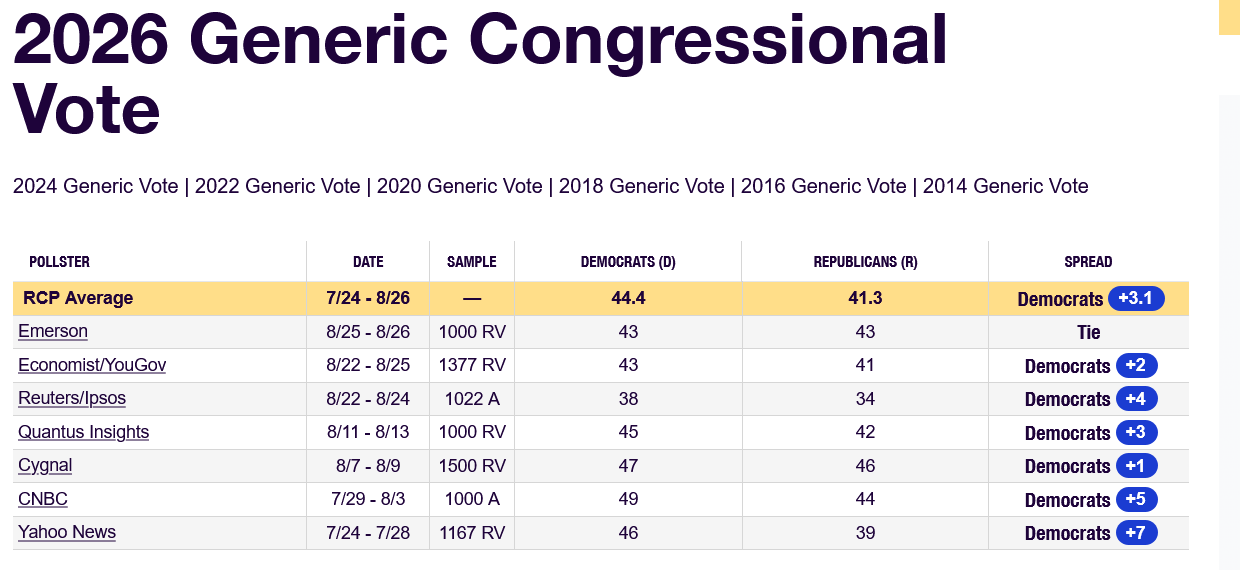
So why are we getting this unhappy news just ten months later (courtesy of RealClearPolitics)?
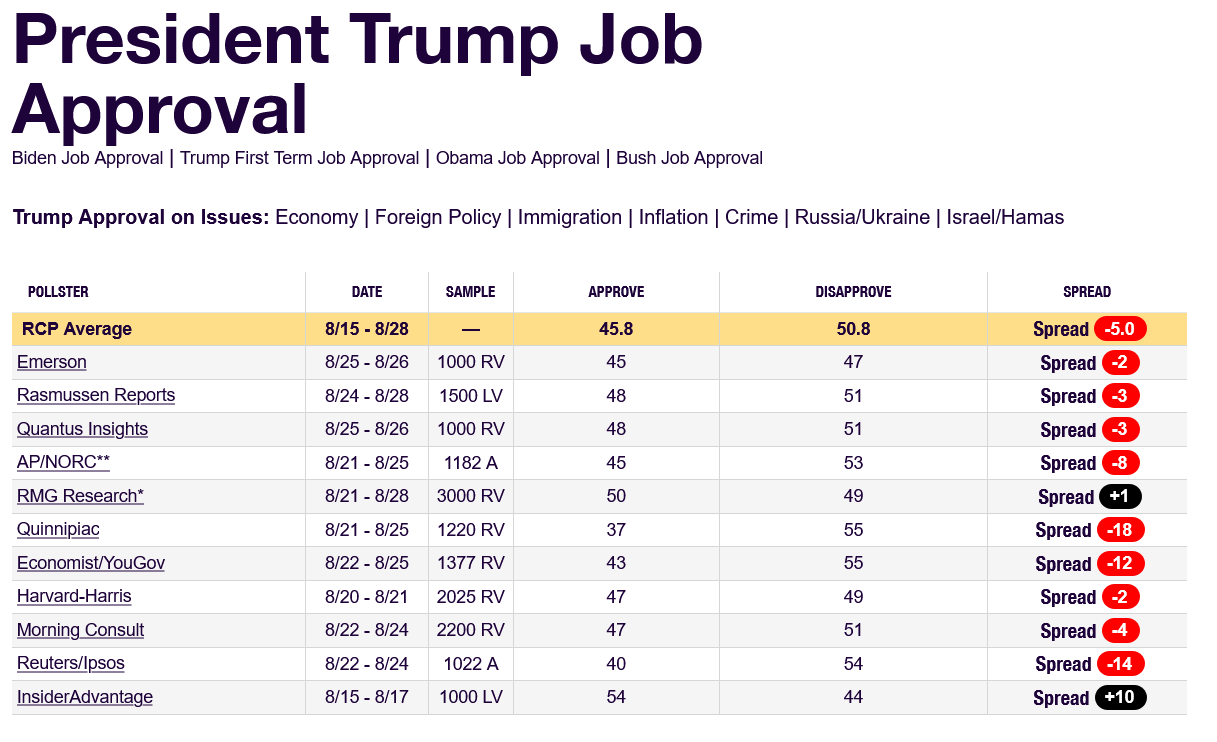
And this less-than-chipper report on Trump’s job approval:
To add one more contrary wrinkle, exit polling last November showed more voters identified as Republicans than Democrats — the first time that had happened in a presidential election since the 1930s.
What’s going on? Henry Olsen writing in the New York Post has a sharp eye, pointing to the rising share of people registering as independents:
That share rose from 30.2% in January 2021 to 32.5% in August 2025, an increase double the 1.1 percentage-point rise in GOP voter registration.
This means many people left the Democrats only to choose neither major party.
They may have voted for Republicans in November, but they remain unwilling to commit themselves to the GOP.
The fact that Republicans gained registrants and Democrats lost them over the last several years can be stated another way: The shift occurred when an obviously aging and incompetent Joe Biden was President and we had, in significant part because of his COVID “relief” policies — i.e., printing up billions in government checks to send out willy-nilly — the worst inflation in 40 years. This is not to mention uncontrolled immigration to an extent even the press couldn’t hide. Also not to mention unjust, illegal and divisive policies promoting racial division. Nor to mention an odd but loud romance with transgenderism.
You get the idea. Biden’s performance and the decline in Democratic registration were not coincidental.
For all their bizarre thinking, the Democrats are unlikely any time soon to give their opposition a neon-lit gift quite like that. This is good for the country but a warning to Republicans: Last year’s election climate is unlikely to be repeated. Instead, Biden et al. will recede into the past, while the MSM will be happy to take the megaphone to any of Trump’s missteps (and of course to lie about his successes by painting them as missteps). So the drift toward aligning as independent might well continue. As Olsen notes, (emphasis added):
[This summer], independents…out-registered Republicans in deep red states like Alaska, Iowa, Kansas and Oklahoma, and they out-registered both major parties in North Carolina, site of one of next year’s most heavily contested Senate contests.
This wasn’t the case as recently as last November, [the] data show.
The GOP out-registered independents in that month, and added nearly as many new voters as independents and Democrats combined.
The fact that’s not happening anymore suggests swing voters are holding off during Trump 2.0.
This strikes me as slightly euphemistic. Although not in great numbers (yet), more voters seem to be turning sour on Trump.
I want to take note of what’s happening without becoming alarmist. To the extent voters are losing enthusiasm as Trump’s time in office wears on, it’s part of a normal pattern. Familiarity may not always breed contempt, but it does breed disappointment. This is especially likely to be the case when the President makes promises, and self-assessments, in exaggerated terms, as Trump is continuously wont to do.
The bottom line, I think, is pretty obvious, and Olsen sums it up:
First, Democrats have a big problem. From 2020 to 2024, they turned millions of people off to their party. They can’t safely ignore these data: Something must be done to reverse the trend and reconnect with Americans.
Yes, well, good luck with that.
Second, Republicans haven’t yet made the sale.
Yes, they’re gaining in comparison to Democrats, but even more voters remain on the fence.
They will have to be convinced by results.
In other words, we’d be wise to learn from the Democrats’ mistakes. It wasn’t enough for them continuously to screech that Trump was a dictator-in-waiting. Voters knew a lot about Trump from his first term and, more importantly, they knew how they and the country were sinking from the policies the Democrats subsequently imposed on them.
Trump, like most of us, has the defects of his virtues. His virtue is that he wants to, and is in the process of, kicking over the Liberal Establishment table where the cultural elites have been dining for decades. He is, to use a different metaphor, the joyous bull in the china shop. The defect is that being a bull has its limitations, for example in strategic thinking and target selection. Whether, in next year’s election, the virtues outweigh the defects is likely to depend on that old stand-by — results.
I think the reason why so many voters are registering as independents is that (as I've argued on this Substack) both of our two major parties are radical. A lot of Americans aren't. https://ringsideatthereckoning.substack.com/p/are-both-of-our-major-political-parties?utm_source=publication-search
This is a well reasoned analysis, but despite it I still find myself a bit puzzled. Trump is already well known for his pomposity and exaggerations, and he is actually doing pretty much all of the things he stated he would do. This alone is highly unusual for a politician! A few rhetorical questions: Voters don't actually want politicians to do what they say they will do? Voters don't actually want the southern border secure? Voters don't appreciate that Trump recognizes the good guys (Israel) from the bad guys? Voters don't support his efforts at ending the war in Ukraine and trying to make the world a more peaceful place? I would think independents would certainly view these efforts and accomplishments as positive. I guess I could be mistaken though. Perhaps Trump's personality traits are wearing thin and are more important to voters than even these major issues? Also, I wonder if the nonstop negativity of most of the mainstream media and various NGOs has more of an influence on public perception despite their appalling and dishonest recent history. Both political parties have their problems, but rarely has the distinction between them been so well defined. Oh, well.