

A federal grand jury in Alabama last week handed up an 11 count fraud indictment against the Southern Poverty Law Center. The SPLC is either famous or infamous, depending on your point of view, for what it describes as its fight against racism. I’ve seen two brilliant takes on the indictment, both by friends of mine. The first is from Mark Pulliam writing in the Spectator; the second from Hoover Institution Fellow (former UCLA law professor) Eugene Volokh, writing on his blog, The Volokh Conspiracy. I’m going to present both, then give my take, as a former federal prosecutor, on the bona fides of the prosecution.
This is going to be a long entry, but I think it’s worth it both because of the extremely important subject matter — the putative weaponization of law — and the unusual insight and honesty with which both Pulliam and Volokh approach the topic (although they reach different conclusions).
Pulliam’s piece , titled “The tawdry shenanigans of the Southern Poverty Law Center,” starts this way:
In the financial world, most frauds are short-lived. Ponzi schemes such as Bernie Madoff’s eventually run out of new suckers to provide enough funds to pay the phony “returns” promised to earlier investors. When the cash flow dries up, the scam collapses.
The con artists at the non-profit Southern Poverty Law Center have a different racket, and a different problem. Instead of swindling the public with promises of unrealistic, too-good-to-be-true investment returns, the fear-mongering SPLC sold “paranoia porn” to credulous donors, convincing them – falsely – that the country is full of dangerous right-wing extremists who need to be identified and brought to heel.
SPLC’s problem is that in 21st-century America, there is not enough racism and far-right extremism to keep donors sufficiently panicked to continue writing checks to finance the organization’s fat executive salaries, a palatial six-story quarters in Montgomery, Alabama, and a nine-figure investment portfolio (some of which is held in offshore accounts).
Permit me to interject a cartoon here:
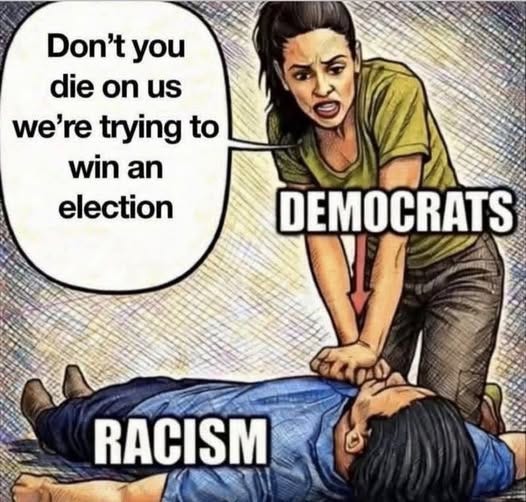
SPLC’s solution? They made up, and even funded, a facade of right-wing extremism. Between 2014 and 2023, they secretly funneled at least $3 million to leaders within the KKK, the Aryan Nation and neo-Nazi groups to create the appearance of an incipient crisis. Manhattan Institute senior fellow Chris Rufo quipped that “the supply of right-wing ‘hate’ was so low that a left-wing ‘anti-hate’ group had to subsidize it, so it could then raise money to fight it.”
This is precisely what a federal grand jury in Alabama found while issuing an 11-count indictment against SPLC this week. The indictment alleges that SPLC committed wire fraud, bank fraud and conspiracy to commit money laundering when it told donors that their money would be used to dismantle so-called hate groups, while SPLC was actually promoting such groups with secret payments through bogus bank accounts. In the words of Acting Attorney General Todd Blanche, SPLC was surreptitiously “manufacturing the extremism it purports to oppose by paying sources to stoke racial hatred.”
The indictment resonates in particular with those of us who recall the notorious 2017 Charlottesville “Unite the Right” rally and how the Left went to town in its aftermath, inter alia painting Donald Trump as a crypto-Nazi. As Pulliam explains:
The indictment alleges that the SPLC has systemically defrauded its donors by perpetrating a hoax, claiming that the country is on the brink of an extremist takeover while secretly fomenting the activities of extremist groups. It helped engineer one of the most highly publicized and bitterly polarizing events in recent history – the violent conflict in Charlottesville in 2017 that resulted in a tragic fatality and many injuries. Among other findings, the indictment states that one of SPLC’s paid operatives (who received more than $270,000 between 2015 and 2023) “was a member of the online leadership chat group that planned the 2017 ‘Unite the Right’ event in Charlottesville, Virginia and attended the event at the direction of the SPLC. [The secret operative] made racist postings under the supervision of the SPLC and helped coordinate transportation to the event for several attendees.”
There might well have been a time when the SPLC was a good-faith civil rights organization. I can’t say for sure, because even I am not old enough to know. I do know that such remnants of its former reputation that might once have existed have been suffering for decades.
The multi-count federal indictment is not SPLC’s first brush with controversy, but it is the most serious. As I recounted in an article for City Journal in 2017, SPLC’s entire legal staff quit in 1986 to protest the organization’s move away from cases involving actual southern poverty, such as pro bono representation of death row inmates, in favor of headline-grabbing lawsuits against impecunious KKK chapters – which served as fodder for lucrative direct-mail fundraising solicitations that became SPLC’s bread and butter. One disillusioned SPLC lawyer, Gloria Browne, charged that SPLC programs were calculated to cash in on “black pain and white guilt.”
Later, SPLC drew criticism for raising far more money than necessary to sustain the non-profit’s operations, leading to the organization receiving an “F” rating from the monitoring group CharityWatch. SPLC has so much money socked away that it maintains hedge fund accounts in the Cayman Islands. SPLC spends more on fundraising than on its legal program.
Perhaps most disturbing has been the SPLC’s penchant in recent years recklessly to smear legitimate conservatives with the broad brush of racism:
Founded in 1971, SPLC has been criticized for labeling mainstream organizations and individuals as “hate groups” and “extremists.” These included the Family Research Council (whose employees were attacked by a gunman in 2012, after SPLC listed the group on its “Hate Map”) and Ben Carson, the retired pediatric brain surgeon, former HUD secretary and one-time presidential candidate. More recently, in 2019, SPLC founder Morris Dees was fired for misconduct, and the group’s President, Richard Cohen, resigned two weeks later. The turnover did not end there. In 2025, amid employee turmoil and a no-confidence vote from the union representing SPLC’s workers, President and CEO Margaret Huang resigned.
Before Turning Point USA founder Charlie Kirk was assassinated last year, the SPLC had branded Turning Point as a “A Case Study of the Hard Right in 2024,” claiming that Kirk “embraced a white nationalist conspiracy theory” and that TPUSA “is sowing and exploiting fear that white Christian supremacy is under attack by nefarious actors, including immigrants, the LGBTQ+ community and civil rights activists.” Kirk’s alleged assassin is an LGBTQ ally. Under president Joe Biden, federal agencies – including the FBI – used SPLC’s reckless labeling to treat law-abiding American citizens, such as traditional Catholics, as “radical extremists” and members of “hate groups.”
With that history, it’s no wonder that so many conservatives have cheered last week’s indictment, seeing the SPLC as having received, finally, the comeupance it’s spent years earning by its vicious smearing, its sanctimony, its greed, and its underhanded, shake-and-jive fundraising tactics.
But here’s the rub. The Department of Justice is not here to deliver “comeupance.” It’s not here to punish sleaze and vice. It’s not here — any more than any branch of a democratic government is here — to take revenge on the opponents of those currently in office. In a government of intentionally limited power, the Department of Justice is here to determine whether, after fair-minded consideration of the facts, a crime as specifically defined by statute has been committed, and only then to wield the fearful power of prosecution.
Hence Prof. Volokh proposes a thought experiment.
Let's say that the SPLC prosecution didn't happen in 2026, and we're now in 2030. Gavin Newsom is President, and the Justice Department announces an indictment. The target is a prominent conservative activist group. The indictment alleges the group raised money by telling conservative donors that it would fight antifa and other sometimes violent left-wing extremist groups. It turns out that it developed an extensive network of paid informants within the leadership of those groups, and indeed paid money to at least one to actually spread leftist extremist messages.
The Justice Department says all this was fraud on the donors, and also that in the process the group had employees open bank accounts using group funds but claiming the funds were personal, and thus lied to the banks and violated anti-money-laundering rules. What would we, as people sympathetic in some measure to the group's overall mission, think?
Yes, what do we think?
[1.] I expect some of us might think the group was being kind of slimy. It’s been talking about all this left-wing extremism it’s fighting, but how much of it was actually ginned up by the group instead?
[2.] At the same time, some of us might think the group is being pretty cunning. Here it’s getting lots of information about its enemies. To the extent it’s prodding some of its paid informants to actually say extremist things, maybe it’s effectively discrediting its enemies. And if we think there really would be plenty of genuine violent left-wing extremism even without the group’s funding, we might think that its spending was actually pretty useful to its stated cause. Slimy and effective, after all, aren’t always inconsistent for political advocacy groups. Sure, the sliminess might on balance cancel out the effectiveness, but maybe not always.
[3.] We might also wonder whether the Newsom Administration is targeting the group because of its ideology, rather than out of a fair application of neutral prosecutorial judgment. That’s always a plausible concern with prosecution of political groups by political actors, but especially in so in a highly politicized time.
Volokh then describes the questions that I think are the crux of his analysis: Is this sort of prosecution common, or is it just something the Administration has ginned up for its political adversaries? Beyond that, were the means used to obtain money from donors actually fraudulent, as that term would be understood in the context of political/advocacy fundraising? As he explains:
We might want to know, for instance: Is it really routine to prosecute groups for having their employees set up bank accounts in the employees' names rather than the group's, not to avoid taxes or to fund organized crime but just to conceal the source of money from check recipients? If such prosecutions are common, then of course a political group shouldn't get a break from them just because it's a political group. But if they're uncommon, then it's more likely that the group is being targeted precisely because of its politics.
And as to the fraud theory, we might wonder: Was the spending really fraudulent? After all, the alleged representations to donors were pretty general—help us dismantle these violent groups that are your and our political enemies. And at that level of generality, there's at least a credible argument that the group was intending to use the money for that general purpose, and perhaps indeed succeeding in serving that purpose. Perhaps some donors would be shocked at the means the group was using. But it sounds like the representations (this will be used to dismantle the bad guys) were about the ends. And such a representation about ends, we might think, doesn't make any commitment about means.
Volokh ends up where, from his questions, you would think he’d end up:
I’m tentatively skeptical of the prosecution. Again, if it turns out that prosecutions for the bank transactions laid out in some of the counts are commonplace, that would change my view as to those counts. Likewise as to the fraud counts, if it turns out that fraud law does routinely treat such behavior as a fraud on the donors, despite the factors mentioned above.
But from what I hear, there really isn’t much precedent for such fraud prosecutions. In any event, though, I think it’s always helpful to think about what would happen if the shoe were on the other foot. Some day soon, it likely will be.
*******************************************
For those readers with the patience and persistence still to be with me, here is where I come out:
Volokh’s two main criteria ((1)whether a prosecution like this is common vs. “conveniently” inspired; and (2) whether in context SPLC’s representations were fraudulent), while worthwhile and important, don’t quite get him to his conclusion.
The main criterion in a democratic system is not whether a given prosecution is common, but whether in this particular case fairly evaluated, the facts could be viewed by a reasonable jury as establishing the prospective defendant’s guilt beyond a reasonable doubt. For one thing, adopting the “common prosecution” criterion leaves open many of the problems it’s supposed to solve. How “common” is common enough to be confident the case isn’t merely political? Will that get decided by the line prosecutors — careerists (or, less generously, bureaucrats) or their more accountable (but also more political) superiors? More importantly, to focus on commonality system-wide is to risk losing focus on why we have a criminal justice system to begin with, namely, to hold wrongdoers to account and give justice to their victims. Contrary to some of my liberal and libertarian friends, I do not see “the system” as being perpetually on trial. Its balance and fair-mindedness are, to be sure, “on trial” before the legislature, which properly has the power to address systemic problems, such as they may appear to be. But they are not on trial in deciding whether Mr. Smith or Mr. Jones from the SPLC fleeced any given contributor by giving him a song-and-dance rendition of what his money would be used for.
The flaw in Prof. Volokh’s second criterion (whether the SPLC’s fundraising actually was fraudulent) is that this is simply a question of fact for the jury to decide. It goes to the strength of the case, not its legitimacy. If the fraud involved what lawyers call malum prohibitum (that is, mere regulatory violations), it might be a different matter; a fair-minded prosecutor would have to doubt whether a prospective defendant would know his behavior was wrong. But this is not such a case. SPLC could not help knowing, as any normal adult would know, that intentionally misleading contributors about what activities they would (and would not) be funding is fraudulent.
The SPLC indictment does raise non-trivial questions about weaponization of law and the boundaries of prosecutorial discretion, but in my view, having been a federal prosecutor under administrations of both parties, falls inside those boundaries.
Bill at his best. I was surprised enough at his conclusion to be persuaded by it.
Thank you, William, for this masterful analysis. I'm surprised and disappointed by the meek and timid handwringing of Prof. Volokh; how can he not see that this is a legitimate case of substantial fraud ?