
Who won the shutdown and who lost?
Nate Silver, a liberal Democrat but an honest guy, thinks the Democrats lost. I don't think we can tell yet, but it doesn't feel like much of a win for Republicans, who supposedly run the show.

As AOL reports, a Sunday night Senate deal seems to have resolved the longest government shutdown on record after a group of Democrats dropped their demand for a guaranteed extension of Obamacare subsidies.
The agreement opened the way for a Senate vote “in which eight Democratic defectors voted to break the filibuster and clear the first hurdle to reopening the government after nearly six weeks.” Their move will come as good news to those whose finances have been disrupted by the shutdown, mainly, at the moment, food stamp (or so-called “SNAP”) recipients. But, as AOL notes,
…the compromise was opposed by some key party leaders and is already igniting a firestorm of protests from progressives who accuse their more moderate colleagues of disastrously backing down, handing President Donald Trump a victory and turning their backs on millions of Americans who can’t afford spiking health care premiums.
That seems to be true as far as it goes. But there’s more to the story. As Nate Silver points out in his piece today, “Trump made a huge blunder on the shutdown. So why did Democrats cave anyway,” Trump started to lose ground as the shutdown dragged on:
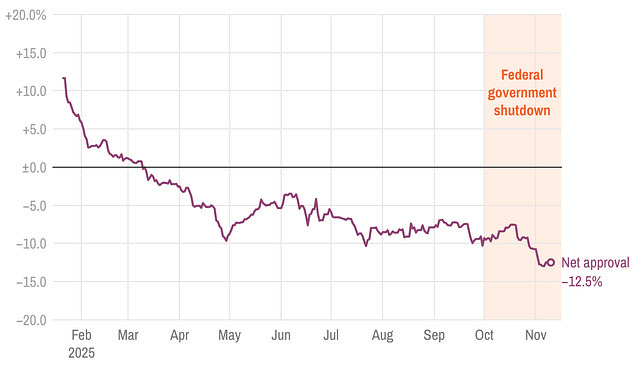
Late last month, Trump’s numbers began to sink, with his net approval rating falling from −7.5 on Oct. 17 to −13 three weeks later. It wasn’t a huge shift in absolute terms. But Trump has had a high popularity floor and a low ceiling. It was something real enough to contribute to Democrats absolutely crushing Republicans in a series of elections last Tuesday in New Jersey, Virginia and other states. Meanwhile, Trump was starting to feud with Congressional Republicans, urging them to “nuke” the filibuster when leadership was reluctant to do so.
This is what it looks like:
Silver, shaking his head, then wonders, “so what did Democrats do with their newfound leverage? Over the weekend, they just gave up.”
The shutdown isn’t technically over yet, but Republicans can now pass a budget bill on a party-line vote, so Democrats gave up all their leverage.
As someone who is supposed to take three cross-country flights over the next seven days, I’m happy that I won’t miss my meetings, I guess.
But as political strategy, I think this is malpractice. Predictable enough malpractice for a perpetually risk-averse party with a weak, unpopular leader who clearly doesn’t have confidence of his caucus. But malpractice all the same.
It seems to me that Silver both overstates and understates the Democrats’ political standing in the wake of the shutdown’s end. He overstates it in believing that the Dems have an “unpopular leader,” by whom he means Chuck Schumer. Actually, they have no leader at all. Schumer is a hyper-partisan, cranky old man and comes across as exactly that. I guess this is better than Ms. Vibes Kamala Harris, or not-really-there Joe Biden, but a “leader” in any recognizable sense Chuck Schumer is not. He can’t handle his own caucus.
Yet Silver understates the Democrats’ current position because he misses the forest for the trees. He need only look at his own figures: Trump is weaker politically now that at any point in his second term, and his handling of the shutdown, if one can call it that, is a big part of it. He has a problem with a cancer, anti-Semitism, in his own party, as I have noted earlier. He continues to make silly blunders, most recently wanting to name the new Redskins Commanders stadium after himself (can you imagine Reagan doing that?), and, most importantly, he seemed largely indifferent to the main job he has as head of the executive branch, namely, just keep the darn government operating.
It might be a government massively too big and too nanny-state by any seriously conservative standard, and it might be a government plagued by incompetence in one place after the next, but it’s the government we have. Beyond that, Trump’s party has majorities in all three branches. The public will, I would think, be able to understand a disagreement about funding that lasts a week or two, but six weeks? And the crunch, it seems to me, was just where Silver saw it — the imminent disruption of air travel. Not many people in the middle class are on food stamps, but they fly by the millions, and having to check every couple of hours whether your flight is still on gets grating real fast.
Overall, it’s hard to see any winner in the shutdown. The Democrats didn’t get what they spent weeks insisting was essential to the Republic, e.g., an extension of already bloated government healthcare benefits, and they folded. The Republicans, ostensibly running the show in DC, showed they didn’t really run it and seemed, only slightly under the surface, to be content with that; I suspect their uniformly dismal results in last week’s elections were in part a message about that, although I have no polling to prove it.
When you’re in charge, you take the responsibility for outcomes. Trump and his allies are in charge, and it’s hard to see where the shutdown benefited anyone.
UPDATE: The NYT story tonight tells the tale on how the eight Democratic senators felt able to break away from Schumer:
But as the impact of the shutdown worsened and radiated across the nation, with flight cancellations racking up ahead of Thanksgiving travel and rising uncertainty around accessibility to food stamps, moderate Democrats were ready to break from their party. In the end, the eight who did were all senators who could afford to take a political hit; two are retiring while the other six are not up for re-election next year.
Assuming it holds, I think it is a win for the legislative branch. The Senate seems to have managed to put a sufficiently bipartisan deal together more or less on their own, rather than relying on the White House, with the involvement of actual members rather than just leadership. And the impetus for it was that I think that they sensed Americans were ready for.
Conversely it seems like a loss for hyper partisans, especially on the left, who prefer a perpetual manichean fight where they are on the side of goodness and light and their opponents in the side of evil and darkness. To be sure it's a pretty basic win. Funding the government for a month to facilitate a much delayed annual appropriation for most of the federal government shouldn't require great legislative prowess. But it does feel a bit like the exercise of muscles that were beginning to seem as if they had almost completely atrophied.
I think we all know that Trump's way of being will never allow his approval to truly go into the positive range. As Churchill once said of a colleague "He has none of the vices I admire and all of the virtues I hate." Except Trump has no virtues. He lacks prudence, humility wisdom and self control. And he is dragging the entire body politic down with him. He will always say something that will enrage half the country and annoy at least another quarter. And consequently he will always miss opportunities. I will never accept that this is the only alternative to Schumer, Pelosi or the radical left.